The valley you're born in should not determine your access to higher education.

Children in Nuristan begin school in a language they don't speak at home, and reach Afghanistan's national university exam without the teaching students in the cities take for granted. We work to close that gap — teaching after school in the village of Nishegram, and preparing its strongest students for the exam in Kabul.

We report transparently to donors and protect the students and communities we serve.

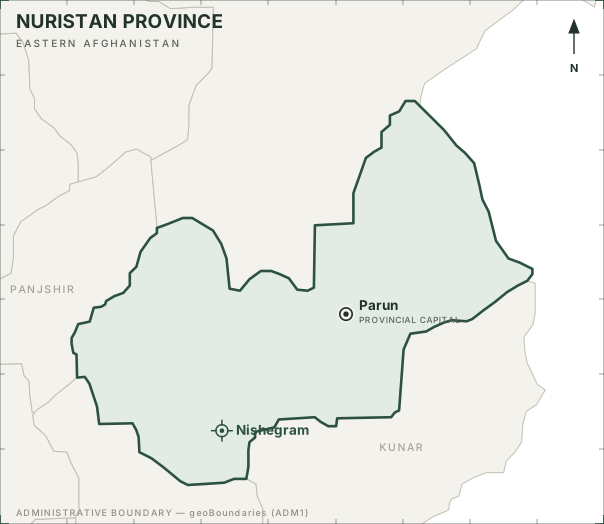
Map of Nuristan province in eastern Afghanistan, drawn from geoBoundaries administrative boundary data, with the provincial capital Parun and the village of Nishegram marked.
Nuristan province in eastern Afghanistan, with Parun and Nishegram marked. Source: geoBoundaries.
The barrier

A national exam, a remote province, and a language gap from the first day of school.
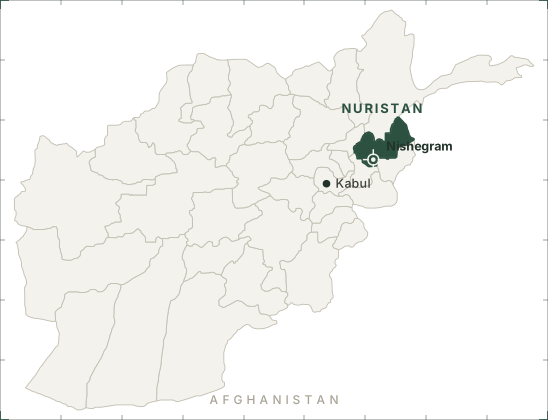
Map of Afghanistan with Nuristan province highlighted in the east and the village of Nishegram marked.

In Afghanistan, university begins with a single exam. The Kankor decides who wins a public university place — and students in Nuristan reach it carrying a disadvantage they did nothing to earn.

Nuristan is a province of steep, forested valleys; its capital sits more than eight hours by road from the nearest city. Its schools run short of teachers, short of sound buildings, and through long, hard winters. And every lesson and every textbook arrives in Dari or Pashto — languages Nuristani children do not speak at home. They learn to read in a language that isn't theirs, and the gap that opens on the first day of school is still there years later, in the exam hall that decides everything.
Our approach

Disciplined teaching, rooted in the community, measured honestly.

Everything we do is held to three rules.

Exam-focused academics

We teach the subjects the Kankor weighs most heavily — mathematics, physics and chemistry, English, and academic reading and writing — with timed practice and mock exams, so the exam is familiar long before exam day.

Community ownership

Every student joins through an agreement signed by a parent or guardian. In Nuristan's close-knit communities, that family commitment is what keeps a child in their seat — and out of household labor during study hours.

Evidence & safeguarding

Monthly assessments and attendance records make progress visible. And we stay deliberately discreet in public — to protect students, especially girls, and to keep the program's standing in its community secure.

Our programs

Two connected tracks, one pathway.

We tested both programs with private funding before turning the work into a nonprofit. Both are running today.

Program One · Nishegram

After-school teaching in the village

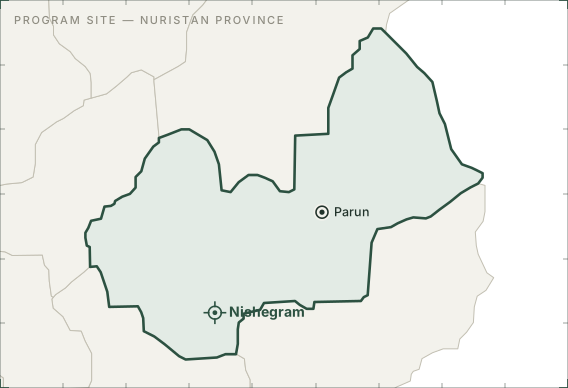
Map of Nuristan province locating the village of Nishegram, where the after-school program runs, and the provincial capital Parun.

Now in its fourth year, this program teaches roughly 50 to 60 middle- and high-school students — after school and through school breaks, with attendance tracked and progress checked every month. Demand from families has been strong, and in our own records, students in the program are outperforming comparable students who are not.

  • Core subjects: mathematics, physics & chemistry, English, reading & writing
  • 50–60 students enrolled, roughly ages 11 to 18
  • Planned: teacher training, winter heating, and phased computer literacy with digital safeguards
4th
year running
$200/mo
current running cost
Program Two · Kabul

The Kabul Bridge Cohort

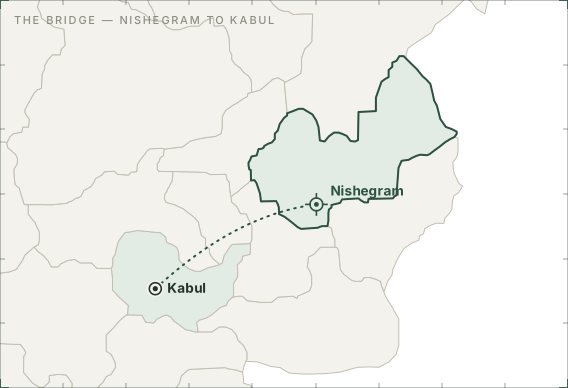
Map of the route from Nishegram in Nuristan to Kabul, where the bridge cohort relocates for intensive preparation.

The strongest students are chosen by competitive testing and teacher recommendation, and move to Kabul for six to nine months of intensive preparation. They get subject teaching, language immersion, and disciplined daily study routines — and an on-site monitor who looks after housing, attendance, and welfare. Six students are in the cohort now.

  • 6 students currently in the cohort, with an on-site welfare monitor
  • 6–9 months of intensive STEM and English preparation
  • Mock exams, timed practice, and a curriculum mapped to the Kankor
~$80/mo
per student
$480/mo
cohort running cost
What we run today

What your support keeps running.

Not projections, not plans. These are the programs operating right now — and what they cost to keep open.

50–60
Students in the Nishegram after-school program
4th
Year of continuous operation in the village
6
Students in the Kabul Bridge Cohort today
$8,160
Runs both programs for a full year at current scale

We publish only what we can stand behind. See the full transparency summary.

Safeguarding

Why you won't see students' faces on this site.

Afghanistan is the only country in the world that broadly bars girls and women from secondary and higher education. In Nishegram, local authorities currently allow our program to run, girls included — but we treat that permission as something to protect and watch closely, never as settled.

So our public communications are built around safety and discretion. The illustrations on this site deliberately stand in for photographs we will not publish, and every donor report uses aggregate figures — never a name, never a face, never anything that could identify a child.

Where we're headed

Goals we can be held to.

We publish only the targets our board has approved and our monitoring can stand behind. The full monitoring framework and finances are on the Impact & finances page.

2026–2027

In our first full year, we will keep the Initiative's California registration current and file its first IRS Form 990, put standardized testing and aggregate attendance reporting in place, sustain the six-student Kabul Bridge Cohort through a complete preparation cycle, and begin growing village teaching from its $200-a-month baseline toward a full four-teacher staff as funding allows.

The three-year horizon

Within three years, we want steady village enrollment with retention tracked year over year, an honest participant-versus-non-participant comparison where it is ethically sound to make one, and Kankor results we can follow — with a plain, stated target of at least five university admissions a year. We will expand only where safeguarding and local permission hold.

Get involved

Ways to help.

The budget is small. The leverage is not — every kind of support has a clear, specific use.

  • Introduce a funder Workplace matching, donor-advised funds, and family foundations can multiply a single gift. See giving options
  • Share the work Help people understand the barrier itself — the distance, the language, the exam — not only the fundraising ask. Read the impact summary

Open the pathway for one more student.

A gift of any size goes to teaching, exam preparation, and student welfare — and to the honest, accountable operations that keep the work alive. At today's scale, about $44 covers a student's full year in the village program.